Friday, February 28, 2020

Day 11 Douglass/Twain

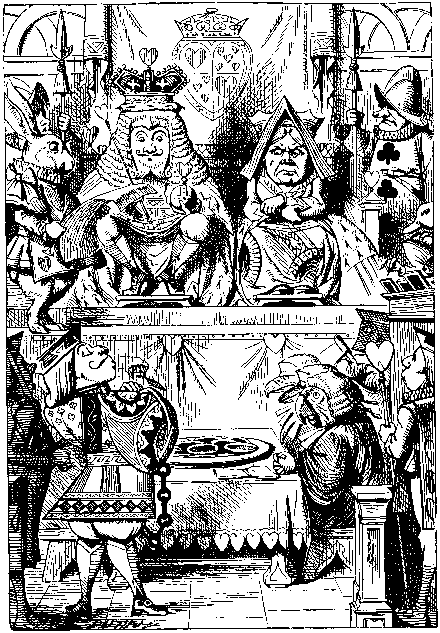
Image result for alice in wonderland court scene
The court scene from Alice's Adventures in Wonderland
DO NOW: Talk with your group about your experiences with satire: Where have you seen it? What is it? What’s its purpose?

Learning Targets:
-Confront issues of prejudice and identity in America today
-Employ sensitivity, respect. and open-mindedness to discuss important issues with which everyone has different experiences
-participating at least once in today’s conversation
-reflecting in writing by answering Survey Questions

AGENDA:
1) The Simpsons "Itchy & Scratchy & Marge" "Mapple"

Key and Peele (read on: Zadie Smith's New Yorker profile of Key and Peele)

2) Satire - fill out all the boxesList of possible satire examples

3) On a piece of poster paper, you and your partner will create and evaluate an example of satire. In your poster, include:
-Visual with an explanation/caption/headline of the story
-Target
-Technique and Message
-Risk

SUMMARIZER: Is satire (always) effective?

HW: Watch the 60 Minutes segment and share your questions/reflections in a 5-7 sentence paragraph.

Wednesday, February 26, 2020

Day 10 Douglass/Twain


Do Now: What's wrong with the sentence below?

It was a beautiful day there was not a cloud in the sky.

Today's Learning Target(s): I will be able to use rhetorical modes and devices in my own writing.
I will know that I have hit the learning target when...
-I can choose a rhetorical mode or device to include in my paragraph.

-I can revise my paragraph with focused correction areas in mind.

Agenda:
  1. Chapter XI (see Part II Chapter I for Douglass's "escape from slavery" story)
  2. What will you carry with you from the Narrative?
  3. Paragraph revisions and posting 
HW: From Douglass to Twain - Please read and annotate this article:  http://www.syracuse.com/kirst/index.ssf/2011/01/the_huck_finn_debate_a_brillia.html  
Prepare at least one question you have about the article or what it addresses.

Tuesday, February 25, 2020

Day 9 Douglass/Twain

Image result for frederick douglass museum baltimore
Frederick Douglass - Isaac Myers Museum, Baltimore
Do Now: "If you don't stand up for something, you'll fall for anything." 

Today's Learning Target(s): I will be able to discuss how stories and rhetorical strategies can change - or at least challenge - people's stereotypes.
I will know that I have hit the learning target when...
-I can find an example of a rhetorical strategy Douglass uses in chapter ten of his autobiography.

-I can explain the purpose of particular rhetorical strategies in Douglass's autobiography.

Agenda:
  1. Chapter 10
  2. What influences Douglass to stand up to Covey?
  3. "If you don't stand up for something, you'll fall for anything." 
  4. Paragraph
HW: Finish your paragraph if you did not do so during class. Read and annotate chapter 11 (https://www.ibiblio.org/ebooks/Douglass/Narrative/Douglass_Narrative.pdf)

Monday, February 24, 2020

Day 8 Douglass/Twain


Do Now: Silently re-read the first two paragraphs of chapter 6. How does Douglass describe Mrs. Auld?

Today's Learning Target(s): 
I will be able to make connections between Douglass's autobiography and Malcolm X's autobiography.

I will know that I have hit the learning target when...
-I can point to ideas in the two different texts that are related.

-I can explain how literature opens a discussion across generations.

Agenda:
  1. Questions on Chapters 6-7
  2.  Making Connections
  3. Beginning Chapter 10
  4. Exit Ticket: Why is it important that we read slave narratives, especially before reading Huck Finn, a book that takes place in antebellum South about a white boy and a black man seeking route to the North?
HW: Read and annotate Chapter 10.  (A pdf copy is here if you prefer; Chapter 10 is on pages 51-85.)

Friday, February 14, 2020

Day 7 Douglass/Twain

http://theweek.com/cartoons/index/210959/the-rhetorical-rhetoric
Do Now: Share your questions/observations from the TED talk.

Today's Learning Target(s): 
I will be able to explain how a text illuminates or conceals truth.

I will know that I have hit the learning target when...
-I can read and annotate a speech, taking note of rhetorical strategies.

-I can make a claim about whether the speech uses rhetoric to illuminate or conceal truth.

Agenda:
  1. Chapter II Annotations
  2. Persuasion and Social Media
  3. Research Please choose a speech from the list
  4. Submitting Your Claim Use this document to record your research and claim
  5. Exit Ticket: What about rhetoric do you better understand? What do you still have a question about?
HW: Read and annotate Chapters 6-7.

Please read the article "The Dangers of Rhetoric" and take special note of how rhetoric has the potential to be used with both good and bad intentions.

Wednesday, February 12, 2020

Day 6 Douglass/Twain


Do Now: Share one of your annotations with your group. What did you have questions about or what stood out to you?

Today's Learning Target(s): 
I will be able to discuss how stories and rhetorical strategies can change - or at least challenge - people's stereotypes.

I will know that I have hit the learning target when...
-I can find an example of a rhetorical strategy Douglass uses in chapter one of his autobiography.

-I can explain the purpose of particular rhetorical strategies in Douglass's autobiography.  

Agenda:
  1. Chapter 1
  2. Reviewing the rhetorical triangle
  3. Prejudice and the power of stories
  4. Exit Ticket: What is one new perspective you gained today?
HW: Watch Paul Bloom's TED talk (it's a little over 16 minutes long) and bring in your notes (at least three notes that could be questions, connections, observations, etc.). Also, read and annotate chapter two of Douglass.

Now read on...
Can people with discriminatory beliefs change?
https://www.newyorker.com/magazine/2015/11/23/conversion-via-twitter-westboro-baptist-church-megan-phelps-roper

Tuesday, February 11, 2020

Day 5 Douglass/Twain

Image result for voices of freedom four classic slave narratives
DO NOW: Please share the summary of the essay you read. What do you have questions about?

Learning Targets:
-Understand the types of rhetoric (pathos, logos, ethos) Douglass uses in his autobiography

AGENDA:
1) Finishing posters - current events (search for your term in a recent news story or a story that works as an example of your term without naming it)
2) Please silently read Slavery in America. 3-5 minutes.
3) Frederick Douglass Bio
If time: Ted Talk: Why Do We Create Stereotypes? or Ted Talk: Can Prejudice Ever Be a Good Thing? with discussion

Summarizer: Why is it important that we read slave narratives, especially before reading Huck Finn, a book that takes place in antebellum South about a white boy and a Black man seeking route to the North?

Monday, February 10, 2020

Day 4 Douglass/Twain

Image result for invisible knapsack
DO NOW: Please take out your reflection on the Implicit Association Test or the article about the test.

Agenda:
What would you do?
2 Conversations about recent concepts
“People who shut their eyes to reality simply invite their own destruction, and anyone who insists on remaining in a state of innocence long after that innocence is dead turns himself into a monster.” -from James Baldwin's "Stranger in the Village"
3 MacIntosh’s article and Discussion Questions
4 Concept posters

HW: Read the introduction to "The 1619 Project." Select one of the essays to read and summarize for tomorrow.

Friday, February 7, 2020

Day 3 Douglass/Twain

Image result for this is water
Do Now: With a partner, discuss “Just Walk on by.” Be prepared to share a question, comment, or connection with the class.

Learning Targets
-Explore the concept of racism as system of advantage based on race.
-Employ sensitivity, respect, and open-mindedness to participate in a discussion about privilege & how to challenge it and reflect on your own experiences of privilege

AGENDA:
Introduction Survey-- Discussions: microaggressions; 5-7 personal experiences; 8-10 derogatory language
1) Implicit Bias definition, video, tests, article
2) Reflection on IAT
3) What would you do?

HW: Please write a response in your journal to either the IAT or the article about the IAT.

Wednesday, February 5, 2020

Day 2 Douglass/Twain

Image result for dr camara jones"
Do Now: Which of the four allegories did you find to be the best aid for understanding and communicating ideas about racism? Why?

Learning Targets
-Explore the concept of racism as system of advantage based on race.
-Build our vocabulary around the subject of racism (e.g., institutionalized racism, personally-mediated racism, internalized racism, etc.).
-Employ sensitivity, respect, and open-mindedness to participate in a discussion about privilege & how to challenge it and reflect on your own experiences of privilege

AGENDA:
1)Introduction Survey Discussion: 1-4 racism, institutionalized, personally-mediated, internalized racism; microaggression; implicit-bias; 5-7 personal experiences; 8-10 derogatory language
2)Microaggression, Left-handed Right-handed activity.pptx
3) Work time
Summarizer: Why are micro-aggressions so harmful?

HW: Read and annotate Brent Staples's “Just Walk on By”. Print a copy of your film review.

Coming up:
White Privilege - MacIntosh’s article and Discussion Questions
Implicit Bias - https://www.nytimes.com/video/us/100000004818663/peanut-butter-jelly-and-racism.html

AP Info Thank you, Mr. Markley!

Tuesday, February 4, 2020

Day 1 Douglass/Twain

Image result for nina simone four women"
DO NOW: What is an allegory? Reflect on allegories you're familiar with and their purpose.

Learning Target:
-Define and understand the importance of realism, romanticism, and slave narrative in the canon
-Examine the role of prejudice in America

Agenda:
1)Dr. Camara Jones’ TED Talk, “Allegories on Race and Racism” Take notes on each (the meaning + examples)

The four allegories: Japanese Lanterns, Dual Reality: A Restaurant Saga, Levels of Racism: A Gardener’s Tale, Life on a Conveyor Belt: Moving to Action

2)Illustrate one of the allegories that includes: allegory title, image, phrase/quotation, and modern example

3)If time - drafting continued

Summarizer: What new insight have you gained in class today?

HW: Answer Introduction Survey and continue working on your review (due Friday).

Additional readings: "How it Feels to be Colored Me" by Zora Neale Hurston

Chicago Tribune article that quotes Martin and Parks

Monday, February 3, 2020

Day 13 TEWWG

Image result for movie review outline"
Do Now: Please take out your pre-writing work for the review. While I check the work, create a list with your group of big ideas in Their Eyes Were Watching God.

1) Central ideas
2) Outlining

HW: Continue drafting your review. Final draft due Friday.